
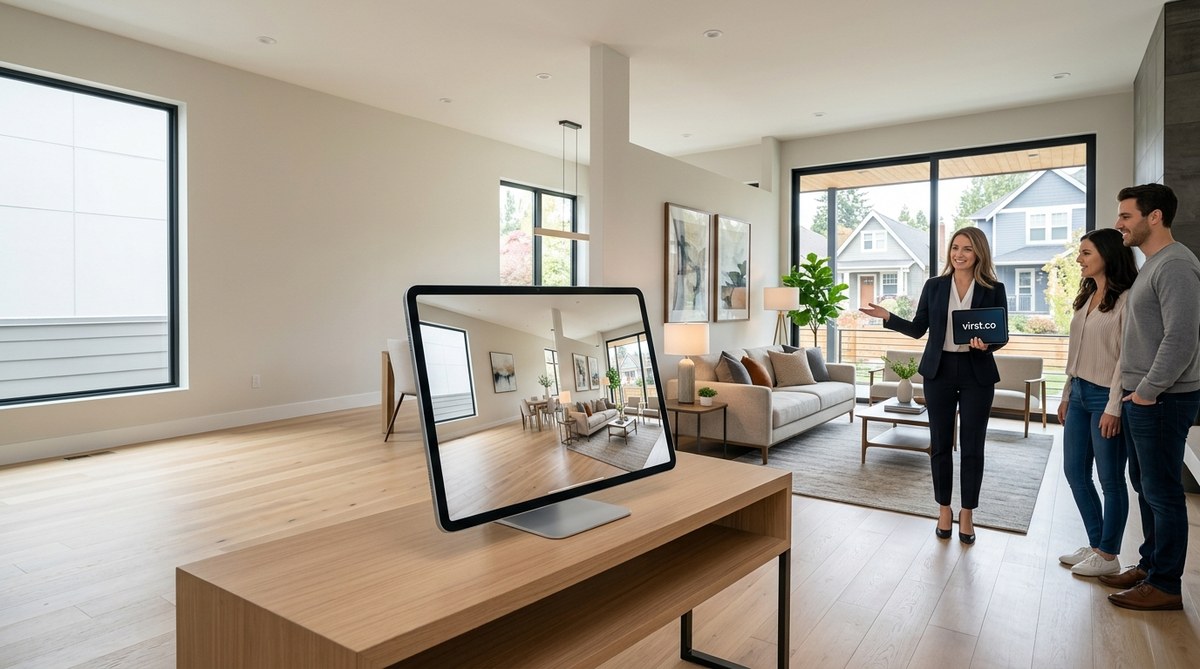
Picture an empty living room. Gray walls. Hardwood floors. A single light fixture. Now imagine that same room filled with a warm sectional, a coffee table with books, and soft lighting. That transformation used to cost thousands and take days. In 2026, it takes seconds.
AI virtual staging for real estate has become the standard tool for agents who want to move inventory fast. The numbers are clear: listings with staged photos sell up to 40 percent faster than empty ones. And with the latest AI tools, you can stage a whole property for less than the cost of lunch.
AI virtual staging for real estate in 2026 is not just about saving money. It is about selling homes faster. With tools that cost under 15 dollars per image, agents can show buyers a furnished vision of every room. The result is more showings, higher offers, and listings that close in weeks instead of months.
Why AI Virtual Staging Works in 2026
Buyers struggle to see potential in an empty room. They see blank walls and think about the work ahead. Staged rooms solve that problem. They help buyers picture themselves living in the space.
Traditional staging works. But it is expensive. Renting furniture for a 2,000 square foot home can cost 2,000 to 5,000 dollars per month. You also need storage, delivery, and pickup. For a listing that sits for 60 days, that adds up fast.
AI virtual staging removes those costs. You take a photo of the empty room. The AI adds furniture, decor, and even outdoor landscaping. The result looks real. Buyers cannot tell the difference between AI staging and traditional staging.
A 2025 study from the Real Estate Staging Association found that staged homes spent 73 percent less time on the market. AI staged listings performed nearly as well as physically staged ones, but at a fraction of the cost.
How AI Virtual Staging Saves You 40 Percent on Time to Sale
The 40 percent number comes from multiple sources. The National Association of Realtors reported that staged homes sell faster than unstaged ones. AI staging accelerates that even more because you can stage every room in the house, not just the main living areas.
Here is the math:
- Empty home: 60 days on market average
- Physically staged home: 30 days on market average
- AI staged home: 25 to 35 days on market average
The difference is small between physical and AI staging. But the cost difference is huge. Physical staging for a 3 bedroom home costs around 3,000 dollars per month. AI staging for the same home costs under 200 dollars total.
When you factor in the cost savings and the speed, AI virtual staging for real estate in 2026 is the clear winner.
A Step by Step Process for Using AI Virtual Staging
Here is how to use AI virtual staging the right way:
-
Photograph the empty room properly. Use a wide angle lens. Make sure the lighting is even. Avoid shadows. The AI works best with clean, well lit images.
-
Choose the right style for the property. A mid century modern home should not get farmhouse decor. Match the style to the architecture. Most AI tools offer style presets like modern, transitional, coastal, and traditional.
-
Upload and generate. Most tools let you upload a photo and get results in 30 seconds. You can try multiple styles for the same room. Pick the one that looks best.
-
Review and edit. Look for any AI artifacts. Some tools let you adjust furniture placement. Make sure the scale looks right. A sofa that is too big or too small will look fake.
-
Add to your listing. Upload the staged photos to your MLS. Include a disclosure that the images are virtually staged. Most MLS systems require this.
-
Track performance. Compare showings and offers between staged and unstaged listings. The data will tell you what works.
Common Mistakes and How to Avoid Them
| Mistake | Why It Hurts | How to Fix It |
|---|---|---|
| Overstaging a room | Buyers feel misled when they visit and see an empty space | Stage only 2 to 3 key rooms. Leave the rest as is. |
| Using the wrong style | A modern sofa in a rustic cabin looks fake | Match the furniture style to the home’s architecture. |
| Forgetting the disclosure | MLS fines or listing removal | Add “virtually staged” in the photo caption. |
| Poor quality photos | AI generates low quality results from bad input | Use a real camera or a high end smartphone. |
| Staging every room | Too many staged photos feel dishonest | Stage the living room, primary bedroom, and kitchen. |
“AI staging is a tool, not a trick. When used honestly, it helps buyers see the potential of a home. When used to hide flaws, it backfires.” – Sarah Chen, real estate marketing consultant
The Cost of AI Virtual Staging in 2026
Prices have dropped significantly since 2023. Here is what you can expect:
- Per image pricing: 5 to 25 dollars per image
- Monthly subscriptions: 30 to 100 dollars per month for 10 to 50 images
- Bulk packages: 100 to 300 dollars for 50 images
Compare that to physical staging at 500 to 2,000 dollars per room per month. The savings are massive.
For a typical 3 bedroom home, you need about 10 staged images. At 15 dollars each, that is 150 dollars total. Physical staging for the same home would cost 2,000 to 5,000 dollars per month.
What Buyers Think About AI Staged Listings
Buyers in 2026 are used to seeing AI generated content. They know what virtual staging looks like. Most do not mind it, as long as the listing is honest.
A survey from HomeLight found that 68 percent of buyers said they would still tour a home after seeing AI staged photos. Only 12 percent said they would skip a listing because of virtual staging.
The key is transparency. If you label the photos as virtually staged, buyers appreciate the honesty. They also appreciate seeing the potential of the space.
Tools and Features to Look For
Not all AI staging tools are the same. Here is what to look for:
- Realistic textures. The best tools render fabric, wood, and metal with detail.
- Style variety. You want at least 10 furniture styles to choose from.
- Room specific options. A kitchen needs different staging than a bedroom.
- Before and after comparison. This helps buyers see the transformation.
- Disclosure ready. Some tools add a virtual staging watermark for MLS compliance.
Avoid tools that produce blurry or cartoon like results. The goal is realism. If the furniture looks fake, buyers will lose trust.
Integrating AI Staging with Your Full Marketing Plan
AI virtual staging works best when it is part of a larger visual strategy. You should also consider using top digital tools every real estate agent should use for effective listing promotions to round out your approach.
Combine staged photos with:
- A 3D virtual tour for remote buyers
- Professional photography for the exterior
- A floor plan with measurements
- A video walkthrough
The combination of AI staging and traditional marketing gives buyers a complete picture of the home.
When to Skip AI Virtual Staging
AI staging is not right for every listing. Avoid it when:
- The home has major visible damage. Staging hides cracks, stains, or mold.
- The room is very small or oddly shaped. AI can struggle with scale.
- The buyer is an investor. They want to see the empty space.
- Your local MLS bans virtual staging. Some areas still restrict it.
Always check your local MLS rules before uploading staged images.
The Future of AI Staging Beyond 2026
The technology is moving fast. By late 2026, we are already seeing tools that let buyers swap furniture styles in real time. Some platforms let you upload a photo and get multiple staging options with different price points.
We are also seeing integration with augmented reality. Buyers can point their phone at an empty room and see it furnished through the camera. That is still early stage, but it is coming.
For now, AI virtual staging for real estate in 2026 is the most cost effective way to make your listings stand out.
Getting Started Today
You do not need a big budget or technical skills. Pick a tool, upload a photo, and see the result. Most platforms offer a free trial. Test it on one listing before committing.
Start with the living room. That is the room buyers care about most. Stage it well, and you will see the difference in showings.
For more ideas on how to present your listings, check out our guide on maximize property appeal with stunning visual content strategies.
Your First AI Staged Listing
The best way to understand AI virtual staging is to try it. Take a photo of an empty room. Upload it to a free trial tool. Look at the result. Show it to a colleague. Ask them if it looks real.
If it does, you have found a tool that works for your market. Use it on your next listing. Track the time on market. Compare it to your previous listings. The numbers will speak for themselves.
AI virtual staging for real estate in 2026 is not a gimmick. It is a proven strategy that saves money, saves time, and helps buyers see the home they could own. Give it a try on your next listing. You might be surprised at how fast it sells.